Listen and subscribe on Apple Podcasts, Spotify, and all major podcast apps.
Paul Stewart grew up in the early 1930s as a Black kid who loved nothing more than playing “Cowboys and Indians” with his friends. He daydreamed about life in the Wild West. That idea of living with no rules and riding from town to town with just his trusty horse by his side.
Though he was just a kid in small town Iowa, he imagined himself in the image of the cowboy. Until one day, little Paul was told by another kid there was no such thing as a Black cowboy. Little Paul was crushed. Not only did this kid burst his bubble, but at the time, the cool cowboys in the movies were all white guys, seemingly proving the kid’s point. Disappointed, little Paul sort of let go of his fascination of cowboys and the wild west.
A few decades later, Paul’s a grown man out in Denver, Colorado with his cousin when he walks past a real-life Black cowboy. Really, the dude was just going about his day, but Paul was awestruck. This dude was in the full cowboy getup that you’d imagine—boots, spurs, gun belt, and of course, a cowboy hat. So much for Black cowboys not existing.
My name is Baudelaire, and this is Atlas Obscura, a celebration of the world’s strange, incredible, and wondrous places. Today, we go to Denver, Colorado, to the Black American West Museum, to hear how little Paul would go on to dedicate his life to telling the stories of the Black cowboys. And along the way, he’d surface stories about Black contributions to the American West.
This is an edited transcript of the Atlas Obscura Podcast: a celebration of the world’s strange, incredible, and wondrous places. Find the show on Apple Podcasts, Spotify, and all major podcast apps.

Paul Stewart didn’t even talk to the Black cowboy he came across in downtown Denver. He was stunned, and it was almost like his younger self came back to the surface. He’d never seen a black man dressed like that, except maybe in his old daydreams as a kid. But now a grown man, he started doing his own research.
He learned about Black cowboys like Nat Love, aka Deadwood Dick, who got his name because he was so fast with his gun in Deadwood, South Dakota, in the years following the Civil War. Or Bill Pickett, who at the turn of the century introduced rodeo audiences across America to bulldogging—an event where, basically, you gotta wrestle a running steer to the ground. Paul soon learned that not only did Black cowboys exist, but just about one in every three cowboys were Black. And beyond that, he learned that Black folks played a role throughout the development of the American West.
Paul was taking in all this new information when he relocated to Five Points, a neighborhood in Denver that at the time was majority black. There, he started a barbershop. But though he was a full-time barber, his inner historian was always at work. While people were getting their cut, Paul would ask them about the histories of their families and of the area. Often, they themselves, or someone they knew, would be directly connected to some of the early Black settlers of the West. By the time they’d come in for their next cut, they’d bring Paul some of those old mementos or pictures from the ancestor that they mentioned last time. Stuff like saddles and rifles from their cowboy great-uncles, or shaven mugs and photographs of their minor grandfathers.
This was like hitting the jackpot for Paul Stewart. He kept everything these folks would allow, and had it all set up in his barbershop for other people to see and learn from. After a few years, the barbershop was really half a barbershop, and the other half was the first iteration of the Black American West Museum. And this museum had a particular focus, from the mid-1800s to the mid-1900s. But as the collection grew, it eventually became too much for Paul’s barbershop.
And that wouldn’t be the first time Paul had that problem. You see, throughout the ’70s and early ’80s, Paul was traveling throughout the American West going to shows and meeting collectors to add to his own collection. Paul’s artifacts and pictures outgrew different homes until the collection finally found a permanent landing place in 1983. And it was possibly an even more unusual home than the barbershop. It belonged to another person who helped shape the American West.
Paul’s customers actually gave him an idea. In the middle of all the history talk, they’d mention to him that the home of a neighborhood luminary was for sale. The thought at the time was that it’d get demolished if the right person didn’t buy it and save it. That house belonged to the first licensed Black female doctor in Denver, Dr. Justina Ford.
And this is where it got really interesting. Paul found out her two-story Italianate-style brick home was more than just her home. It was also the site of her private practice. There she delivered over 7,000 babies across 37 nationalities, and for the record, she knew in the range of eight to 11 languages and dialects.
When she wasn’t attending the delivery of babies, Dr. Ford was a pediatrician and a general practitioner. Imagine how busy this lady was. And you might be wondering why all this had to be done out of her house in the first place. Well, though Dr. Ford got her medical license in 1902, she was denied membership to the Colorado Medical Society, and you needed that membership to practice in the hospital. So she made it all happen out of her home.
Considering the historical significance of her home and his need for a larger space for the collection, Paul Stewart jumped at the chance to preserve the house. It just made sense. He moved his collection, which for the record had tens of thousands of artifacts by this time, into Justina Ford’s home.
From personal mementos, photographs, clothing, paintings, letters, you name it. Then, he and his staff got to work using each room to pay tribute to a different part of the Black history of the American West. Of course, there’s the Black cowboy room. There’s saddles, all types of cowboy hats, and pictures of Black cowboys on every wall doing tricks on their horses.
Throughout the room, there’s also those wooden fence posts like those ones where cowboys would tie their horses to outside of a saloon or something. On the Black American West Museum’s website, there’s actually a picture of Paul Stewart leaning up against one of them with the biggest smile. You gotta figure he had the most fun putting together the cowboy room. His younger self standing in a room full of stuff that belonged to people that at one point he didn’t even believe existed.
Paul and his team also took the house’s dining room that then became Dr. Ford’s office and made it a room dedicated to her legacy. They’ve spread her actual equipment throughout the room, with boards up on the wall with her pictures and more of her story.
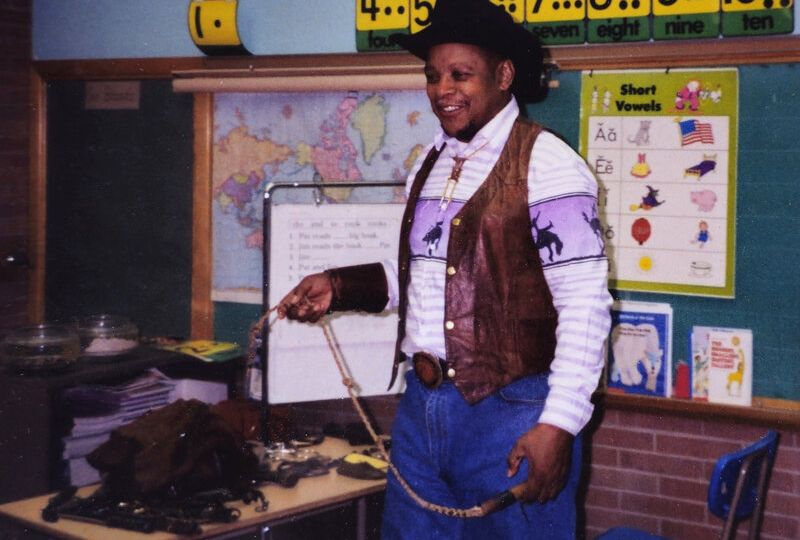
After the museum was up and running, Paul Stewart got on the road himself, traveling to schools teaching kids about Black people’s involvement in the early years of the American West. He began leaning into the anthropology of it all, determined to preserve the stories of people like Dr. Justina Ford and countless other miners, farmers, and explorers who built the American West.
In the midst of that, he got to keep his inner kid happy telling the stories of folks like Nat Love and Deadwood Dick. Paul Stewart passed away in 2015, but even now with him gone, the museum is still full of folks that want to continue that mission, so no other kid could ever be told that black cowboys didn’t exist. Today, thanks to Paul, those kids have a place, a monument, that proves that that couldn’t be further from the truth.
The Black American West Museum is open just Friday and Saturday from 10 a.m. to 2 p.m.
Listen and subscribe on Apple Podcasts, Spotify, and all major podcast apps.
Our podcast is a co-production of Atlas Obscura and Stitcher Studios. The people who make our show include Dylan Thuras, Doug Baldinger, Chris Naka, Kameel Stanley, Johanna Mayer, Manolo Morales, Amanda McGowan, Alexa Lim, Casey Holford, and last but not least, Luz Fleming. Our theme music is by Sam Tindall.